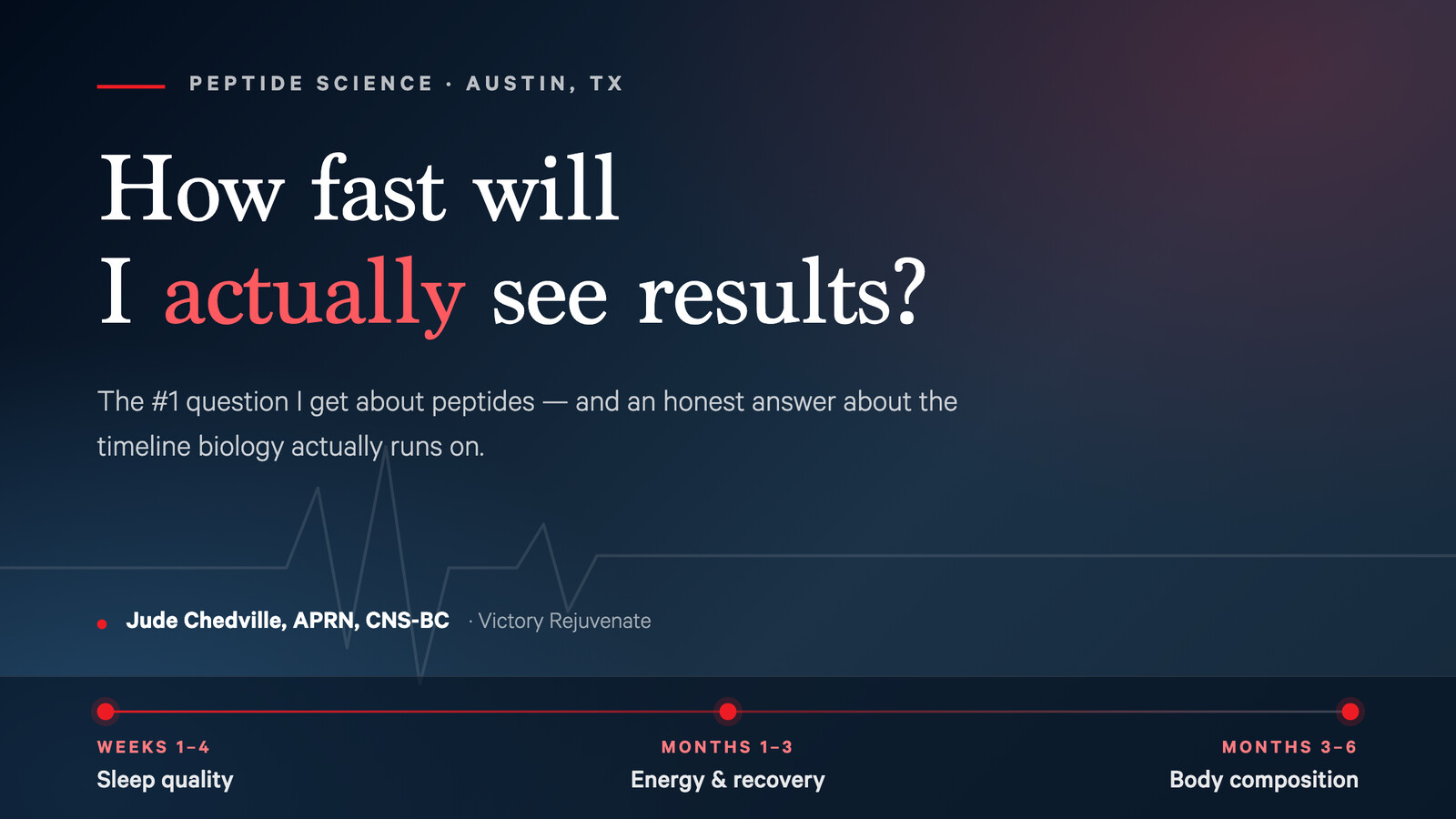
The question I hear most about peptides isn’t “do they work?” Most patients who find their way to my office have already done enough reading to know the science is real. The question I hear most — in the consult room, in follow-up messages, sometimes before we’ve even finished the first appointment — is this: “How fast will I see results?”
Key Takeaways
- For most peptide protocols, the honest answer is weeks to months — not days.
- Peptides are signaling molecules, not stimulants. They restore or amplify signals your body already uses, and biology responds on biology’s timeline.
- On growth hormone–axis peptides, results tend to arrive in a sequence: sleep first, then energy and recovery, then measurable body composition change.
- There are faster exceptions — TA1 can bring relief from illness in 24–48 hours, and many people report feeling better on BPC-157 within a week.
- Clinical trial data mirrors the slower arc: significant visceral fat reduction with tesamorelin was measured at 26 weeks, and the STEP 1 semaglutide trial reached roughly 15% average weight loss over 68 weeks.
- Four things set your personal timeline: your starting point, your age and recovery capacity, the specific peptide and what it targets, and your consistency.
- Commit to at least 90 days, and let objective markers — not week-to-week feelings — decide whether to stay the course or adjust.
My Honest Answer
It depends on the peptide, the goal, and your starting biology — but for most protocols, think weeks to months, not days. And that’s not a hedge; it’s how these molecules actually work.

Peptides aren’t stimulants or quick-fix drugs that force an effect on your body. They’re signaling molecules — short chains of amino acids your body already uses to communicate. Therapeutic peptide therapy works by restoring or amplifying signals: telling your pituitary to release growth hormone in its natural rhythm, nudging cellular repair pathways, improving metabolic signaling. Biology responds to better signals on biology’s timeline.
There are exceptions worth naming. Peptides like TA1 can provide relief from illness in 24 to 48 hours, and with BPC-157, many people report feeling better in a week or less. But those are the fast lane, not the rule.
A Realistic Arc, Month by Month
Here’s the trajectory I share with patients on growth hormone–axis peptides like tesamorelin or CJC-1295/ipamorelin.
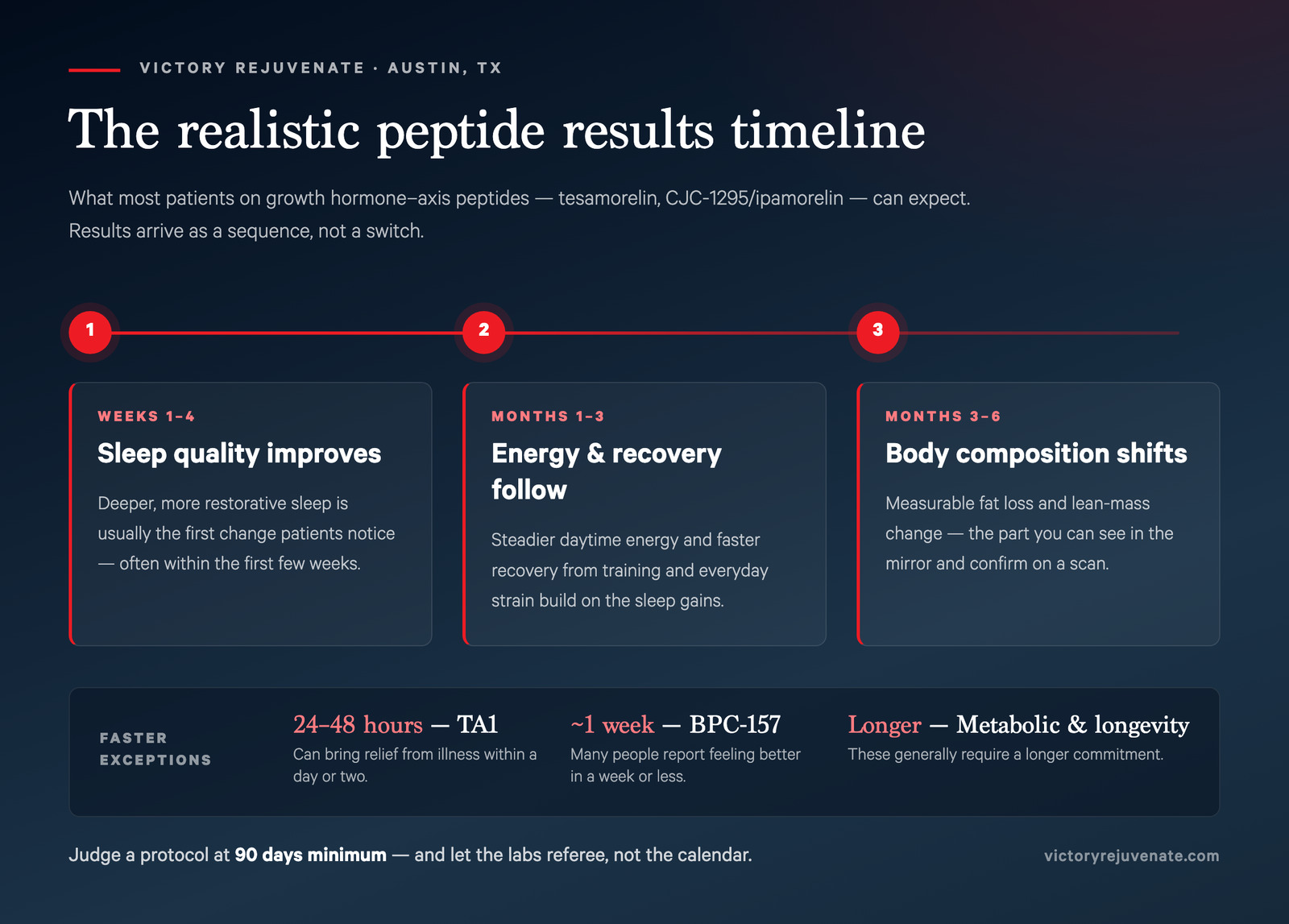
Weeks 1–4: Sleep
Sleep quality is often the first thing to improve, sometimes within the first few weeks. It rarely makes for a dramatic story, but it’s the change that makes everything downstream possible.
Months 1–3: Energy and Recovery
Energy and recovery tend to follow over the first one to three months. Patients describe getting through the afternoon without a crash, or bouncing back from training the way they used to.
Months 3–6: Body Composition
Meaningful body composition change — fat loss and lean muscle shifts you can measure — typically takes three to six months of consistent use.
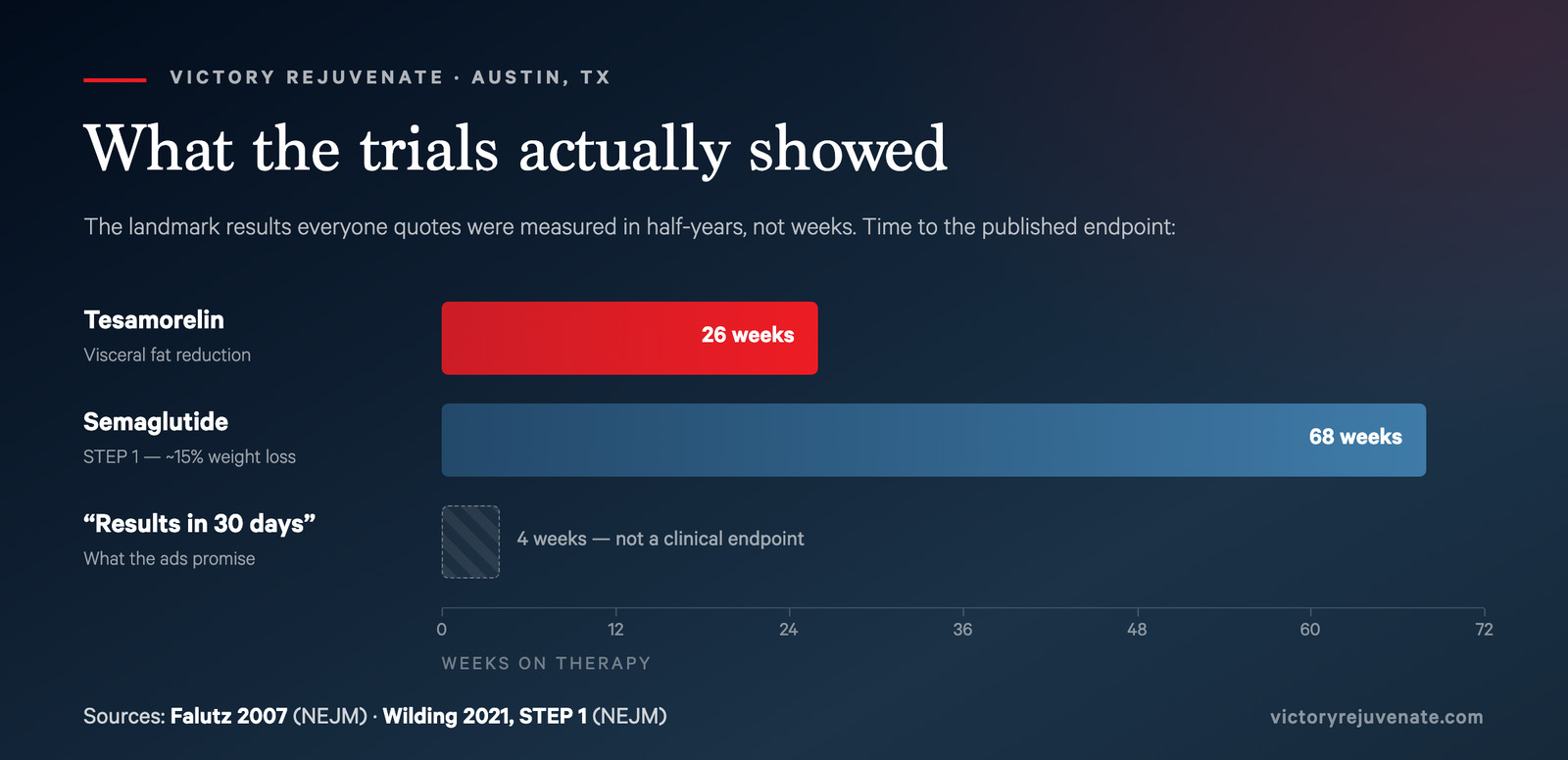
That trajectory mirrors what we see in the published research. In clinical trials of tesamorelin, a growth hormone–releasing hormone analog, significant visceral fat reduction was measured at 26 weeks. Even the GLP-1 medications everyone knows produced their landmark results gradually — the STEP 1 trial of semaglutide showed roughly 15% average weight loss over 68 weeks, not 6.
Why Everyone Asks This Question
I understand exactly why this is the most common question. Most people considering peptides have already tried things that overpromised and underdelivered — supplements, cleanses, aggressive diets. They’ve spent money on “results in 30 days” before. So when they invest in a real clinical protocol, they want to know when they’ll feel the return. That’s not impatience; that’s a fair question from someone who’s been burned.
There’s also a quieter worry underneath it: “If I don’t feel different in two weeks, does that mean it isn’t working?” Almost always, the answer is no. The deepest changes — improved insulin signaling, tissue repair, restored hormone pulsatility — are happening well before you feel them. It’s why we track labs and objective markers, not just how you feel week to week. It’s worth noting that peptides focused on longevity or metabolic health generally require a longer commitment.

The deepest changes are happening well before you feel them. That’s why we measure, rather than relying on how a given week went.
What Actually Determines Your Timeline
Two patients on the identical protocol can have very different timelines, and the difference usually comes down to four things.
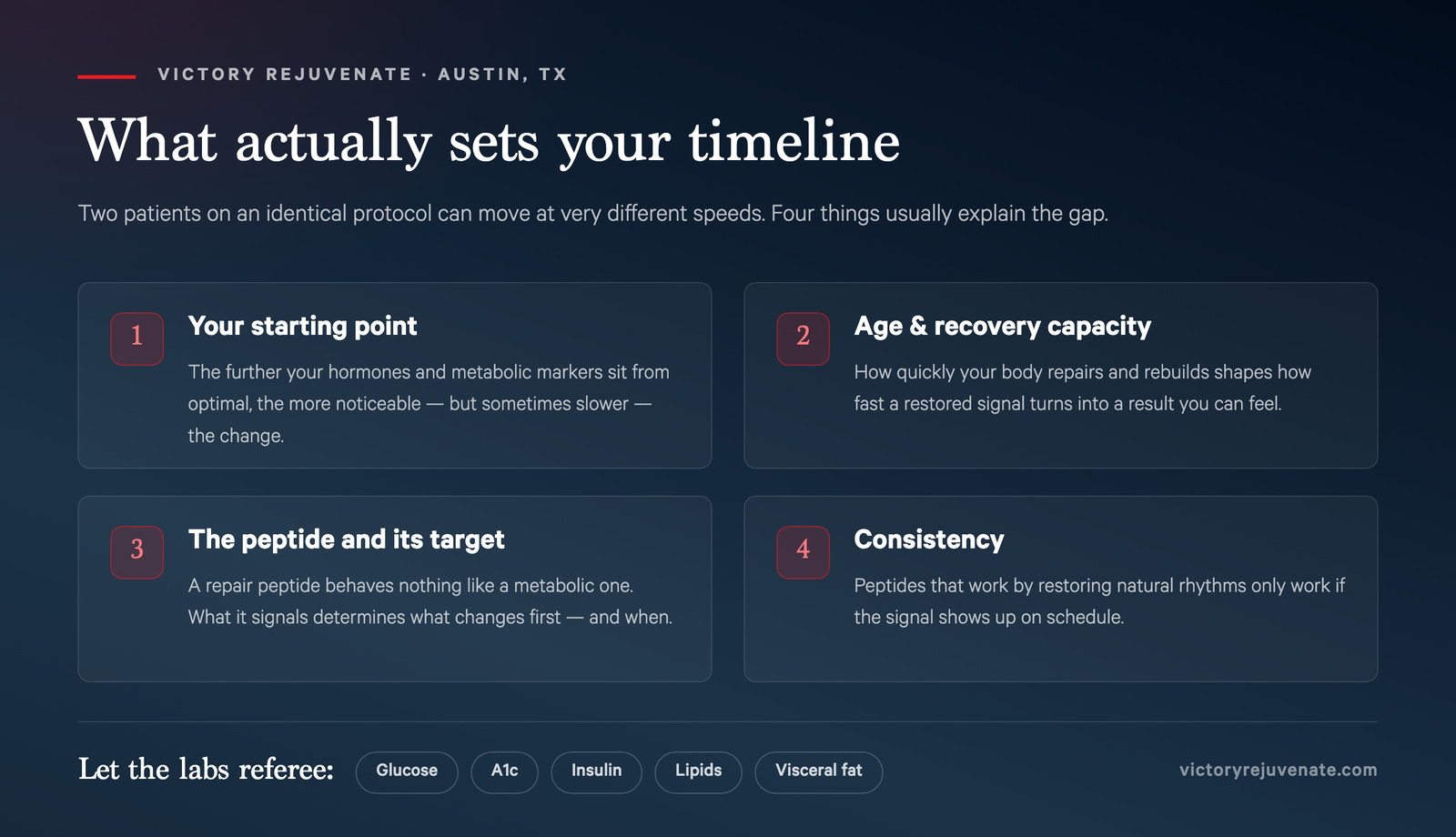
- Your starting point. The further your hormones or metabolic markers are from optimal, the more noticeable — but sometimes slower — the change.
- Your age and recovery capacity. How efficiently your body repairs and rebuilds shapes how quickly a restored signal becomes a result you can feel.
- The specific peptide and what it targets. A repair peptide behaves nothing like a metabolic one.
- Consistency. Peptides that work by restoring natural signaling rhythms only work if the signal shows up on schedule.

This is also why peptide therapy belongs in a supervised clinical setting: dosing, timing, and sourcing quality all materially change both the speed and the safety of your results.
What I Tell Every Patient: Peptides Are Accelerators
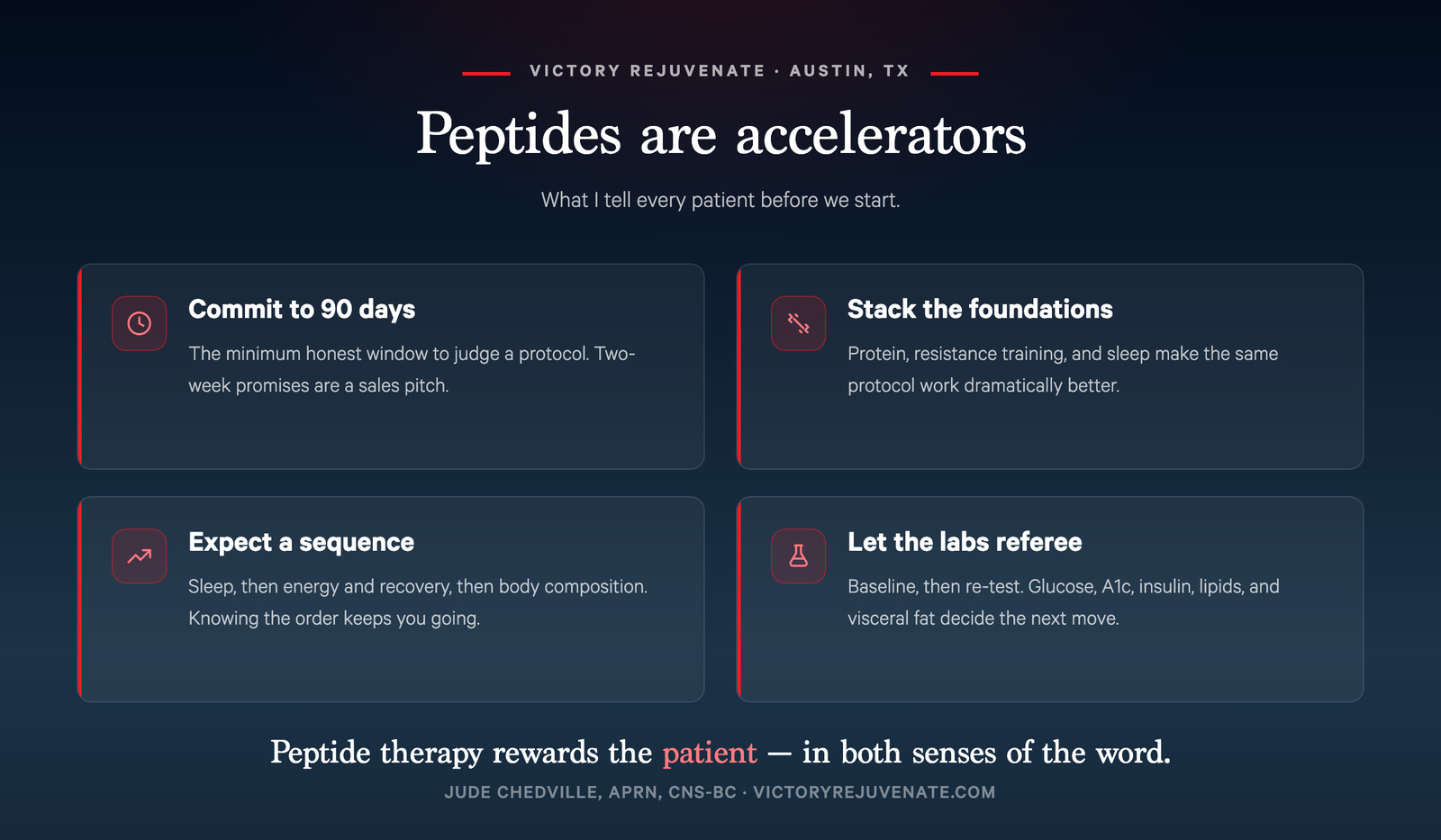
- Commit to at least 90 days. That’s the minimum honest window to judge most peptide protocols. Anyone promising dramatic results in two weeks is selling something.
- Stack the foundations. Peptides amplify what you’re doing. Protein intake, resistance training, and sleep make the same protocol work dramatically better.
- Expect a sequence, not a switch. Sleep first, then energy and recovery, then visible body composition change. Knowing the order keeps you from quitting right before it gets good.
- Let the labs referee. We measure your baseline and re-test. While there aren’t “peptide labs” to measure, we track metabolic markers like glucose, A1c, insulin, and lipids, as well as objective body composition changes like visceral fat reduction, to determine whether to stay the course, adjust the dose, or change the strategy.

Peptide therapy rewards the patient — in both senses of the word. The people who get remarkable results are the ones who give a well-designed protocol the time biology requires.
Got a peptide question of your own? Send it in — I might answer it in the next video. And if you’re ready to find out whether peptide therapy fits your goals, book a consultation at Victory Rejuvenate in Austin.
Frequently Asked Questions
How fast do peptides work?
For most protocols, think weeks to months rather than days. Peptides are signaling molecules that restore or amplify communication your body already uses, so results follow biology’s timeline. On growth hormone–axis peptides, sleep often improves within the first few weeks, energy and recovery over one to three months, and measurable body composition change over three to six months.
Are there peptides that work quickly?
Yes. TA1 can provide relief from illness in 24 to 48 hours, and many people report feeling better on BPC-157 within a week or less. Peptides aimed at longevity or metabolic health sit at the other end of the range and generally require a longer commitment.
How long should I stay on a peptide protocol before judging it?
At least 90 days. That is the minimum honest window to evaluate most peptide protocols. Anyone promising dramatic results in two weeks is selling something.
What if I don’t feel different after two weeks?
Almost always, that does not mean it isn’t working. Changes like improved insulin signaling, tissue repair, and restored hormone pulsatility happen well before you feel them, which is exactly why we track objective markers instead of relying on week-to-week feelings.
How do you measure whether peptide therapy is working?
We establish a baseline and re-test. There aren’t “peptide labs” as such, so we track metabolic markers like glucose, A1c, insulin, and lipids, alongside objective body composition changes such as visceral fat reduction, to decide whether to stay the course, adjust the dose, or change the strategy.
Why does peptide therapy need medical supervision?
Dosing, timing, and sourcing quality all materially change both the speed and the safety of your results. A supervised clinical setting is what makes it possible to individualize a protocol, verify sourcing, and adjust based on what your labs actually show.
Sources
- Wilding JPH, et al. Once-weekly semaglutide in adults with overweight or obesity (STEP 1). N Engl J Med 2021 — nejm.org
- Falutz J, et al. Effects of tesamorelin, a growth hormone–releasing factor analog, in HIV-infected patients with abdominal fat accumulation. N Engl J Med 2007 — nejm.org
- Victory Rejuvenate — Sermorelin Therapy: Natural Growth Hormone Optimization Explained
- Victory Rejuvenate — Tesamorelin: Targeting Visceral Fat & Metabolic Health
Clinical Note: This content is for educational purposes only and does not constitute medical advice. Hormone and peptide therapies should always be managed by a qualified healthcare provider following a comprehensive evaluation.