Aesthetic Medicine
Scarlet RF Microneedling in Austin: 7 Concerns It Treats Best (2026 Guide)
November 5, 202610 min read
Scarlet RF microneedling in Austin is best suited to seven concerns: early skin laxity along the jaw and neck, fine lines and moderate wrinkles, enlarged pores, atrophic acne scars, rosacea-related redness and flushing, rough or crepey texture, and resurfacing goals in darker skin tones where lasers need extra caution. At Victory Med Spa, every Scarlet plan starts with a consultation so a licensed provider can confirm that it is the right tool for your specific concern.
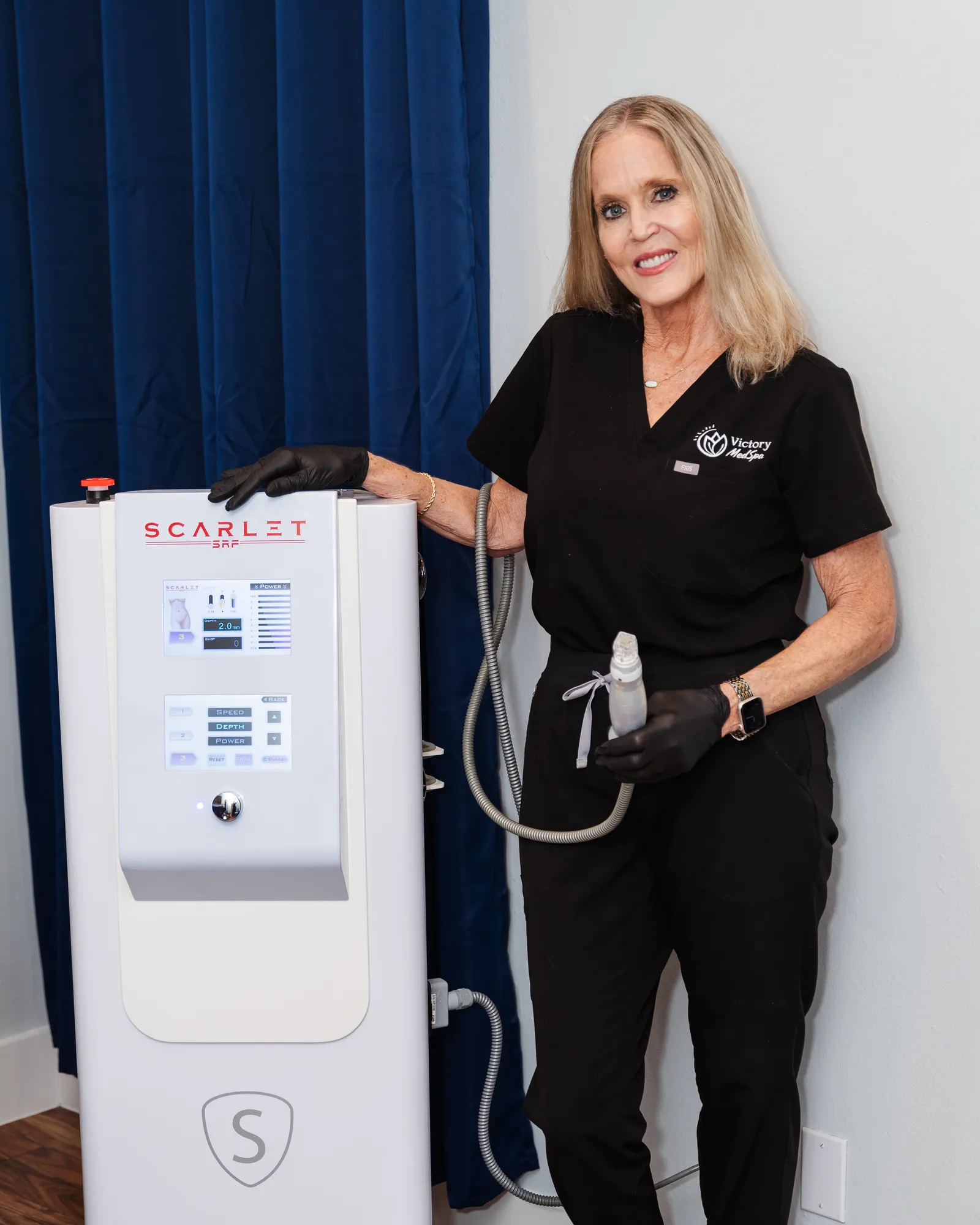
Radiofrequency (RF) microneedling has become one of the most requested skin treatments in Austin, and for good reason. It pairs the controlled micro-injury of traditional microneedling with heat delivered beneath the surface, which prompts the skin to remodel collagen and elastin more robustly than needling alone. The Scarlet system delivers that energy through 25 gold-plated microneedles, creating small zones of coagulation that kick off the skin’s natural repair response.
If you want to understand the engineering behind the device, we cover it in depth in our Scarlet SRF device guide. This article takes a different angle. Instead of asking “how does the machine work,” it asks “which of my concerns is Scarlet actually good at?” That is the question we hear most from patients who visit our studio at 2108 W Ben White Blvd from South Lamar, Westlake Hills, and across greater Austin.
This guide is educational and is not a substitute for an in-person evaluation. Results vary from person to person, and no aesthetic treatment can guarantee a specific outcome.
Key Takeaways
- Scarlet RF is a collagen-remodeling treatment, not a quick fix. Improvement builds over roughly three months as new collagen forms.
- It shines on texture and firmness concerns — laxity, fine lines, pores, and acne scars — where heat plus needling outperforms needling alone.
- It is generally suitable for all Fitzpatrick skin types with appropriate settings, which makes it a common alternative when lasers carry higher pigment risk.
- Downtime is usually short: mild redness for about 24 to 48 hours is typical, though individual responses differ.
- A series is usually recommended, often three sessions spaced four to six weeks apart, confirmed at your consultation.
- Not everyone is a candidate. Pacemakers and other implanted electronic devices, pregnancy, and active infections are contraindications.
How We Choose the Right Treatment for Your Concern
A great result begins with matching the tool to the problem. At Victory Med Spa, our physician-supervised team looks at the concern you care about most, your skin type and Fitzpatrick classification, the degree of laxity or scarring, your medical history, and how much downtime your schedule allows. We also ask whether a simpler or more targeted option would serve you better. Sometimes the answer is Scarlet; sometimes it is traditional microneedling, a targeted Agnes RF treatment, or a laser. If you are weighing the two RF platforms, our Scarlet vs Agnes comparison is a useful starting point.
Scarlet treatments at Victory Med Spa are led by Kristin Laskaris, our CoolSculpting and RF lead and a certified Scarlet SRF provider. Below are the seven concerns where we find Scarlet tends to deliver the most meaningful improvement.
1. Early Skin Laxity on the Jawline & Neck — Best for a Non-Surgical Firming Effect
Mild to moderate laxity is one of the clearest reasons to choose Scarlet over standard microneedling. As we age, collagen and elastin production slows, and the lower face begins to soften along the jawline and jowls while the neck loses some of its crispness. Radiofrequency heat delivered at depth encourages the dermis to contract and remodel, which may produce a gradual tightening and lifting effect.
It is important to set expectations honestly. Scarlet is not a facelift, and patients with significant sagging or heavy skin excess may be better served by a surgical consultation. For patients in the early-to-moderate range, however, a series of treatments can offer visible firming without incisions. When small pockets of fat contribute to a heavy jawline, our team may suggest pairing Scarlet with Agnes RF or CoolSculpting for a more complete contour.
2. Fine Lines & Moderate Wrinkles — Best for Structural Smoothing
Surface lines around the eyes, mouth, and forehead often reflect thinning collagen rather than muscle movement alone. Scarlet’s thermal energy is designed to restructure that collagen network, so improvement tends to be cumulative and progressive rather than instant. Many patients describe their skin as looking “denser” and more rested as the series progresses.
For lines driven primarily by muscle activity, such as frown lines or crow’s feet that deepen when you smile, a neuromodulator like Botox or Dysport is usually the more direct fix. In practice, many Austin patients combine the two: a neuromodulator to soften expression lines and Scarlet to improve the quality of the skin itself. Your provider will help you decide the right sequence.
3. Enlarged Pores — Best for Refining Visible Pore Size
Enlarged pores are a frequent frustration, especially for patients with oily or combination skin and those who spend a lot of time outdoors in the Texas sun. Scarlet’s thermal coagulation zones are thought to tighten the tissue around pore walls, which may reduce how visible pores appear and refine overall texture.
Pores are partly genetic, so the goal is refinement rather than elimination. Consistent home care with appropriate actives and sunscreen helps maintain results, and a monthly AquaFirme facial can keep pores clear between RF sessions.
4. Atrophic Acne Scars — Best for Deep Collagen Remodeling
Rolling and boxcar acne scars are depressions caused by collagen loss during past inflammation. Because Scarlet delivers energy throughout the depth of needle penetration, it can stimulate new collagen beneath those depressions to help lift and soften them over time. Studies on RF microneedling generally suggest meaningful improvement in atrophic scarring for many patients, though deep ice-pick scars can be more stubborn and may benefit from additional approaches.
Scar treatment usually calls for patience and a series of sessions. Some patients also add PRP to support recovery, and patients who prefer a non-thermal approach may start with traditional microneedling. Active acne should be controlled first; if active breakouts are your primary concern, Agnes RF may be worth discussing.
5. Rosacea-Related Redness & Flushing — Best for Calming Vascular Reactivity
One of Scarlet’s more distinctive uses is helping regulate chronic redness and flushing associated with dilated capillaries. This makes it a candidate for some patients with rosacea-prone skin who also want texture and firmness benefits from the same treatment.
Rosacea is a medical condition with many triggers, and not every case is appropriate for RF. Patients with active, highly inflamed rosacea may need to calm the skin first, and some patients do better with light-based options such as BBL, which we discuss in our BBL Hero laser guide. Your provider will evaluate which approach fits your skin.
6. Rough, Crepey, or Uneven Texture — Best for Overall Skin Quality
Not every patient has a single headline concern. Many simply notice that their skin looks less smooth, a little crepey, or less radiant than it used to. Because Scarlet stimulates collagen and elastin across the treated area, it can improve overall skin quality in a way that complements targeted treatments.
Texture is also where combination planning pays off. Some patients pair Scarlet with regenerative home care, such as copper peptides (see our GHK-Cu skin guide), and schedule professional medical facials between sessions to maintain a healthy barrier.
7. Resurfacing for Darker Skin Tones — Best for Pigment-Conscious Rejuvenation
Many lasers rely on light that can be absorbed by melanin, which means darker skin tones (Fitzpatrick IV to VI) require careful settings to avoid post-inflammatory hyperpigmentation. Scarlet’s non-ablative RF delivery does not target melanin, so it is generally considered suitable across all skin types with proper technique.
That makes Scarlet a valuable option for patients of color who want to address laxity, pores, scarring, or texture. Any energy-based treatment can still cause irritation or temporary pigment changes, so a thorough skin evaluation and conservative settings remain essential.
The 7 Concerns at a Glance
| Concern | Why Scarlet Helps | Common Pairing |
|---|---|---|
| Jawline & neck laxity | RF heat encourages dermal contraction and remodeling | Agnes RF, CoolSculpting |
| Fine lines & wrinkles | Restructures collagen for cumulative smoothing | Botox / Dysport |
| Enlarged pores | Thermal coagulation tightens pore walls | AquaFirme |
| Atrophic acne scars | Deep collagen formation beneath depressions | PRP, microneedling |
| Rosacea redness & flushing | Helps regulate vascular reactivity | BBL (case by case) |
| Rough or crepey texture | Broad collagen and elastin stimulation | Medical facials, GHK-Cu |
| Darker skin tones | Non-ablative RF does not target melanin | Custom home care |
What to Expect at Your Scarlet RF Visit
Your first appointment begins with a consultation. Your provider reviews your goals, skin type, degree of laxity or scarring, medications, and any implants, then maps a plan. Pricing is reviewed at the consultation, and PatientFi financing is available for patients who prefer to spread out the cost of a series.
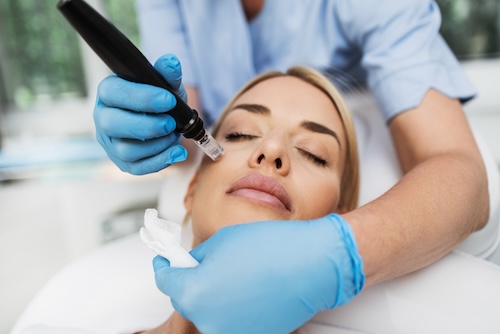
On treatment day, a topical anesthetic is applied for about 45 minutes to keep you comfortable. The Scarlet handpiece is then passed systematically over the treatment area for roughly 30 to 60 minutes. Most patients describe a warm, prickling sensation. Afterward, mild redness is common for 24 to 48 hours, and most people return to normal activities quickly. Gentle skincare and diligent sun protection are important while the skin heals.
Results build progressively. Some patients notice a difference after the first session, but the most meaningful changes typically appear about three months after completing a series, which is often three sessions spaced four to six weeks apart. Your provider may adjust the number of sessions based on how your skin responds.
Safety, Side Effects & Who Is Not a Candidate
Scarlet RF is a medical procedure and should be performed by a qualified, trained professional under physician supervision. Common, temporary side effects include redness, mild swelling, warmth, and a sandpaper-like feel for a few days. Less commonly, patients may experience pinpoint marks, bruising, breakouts, or temporary pigment changes. Infection is rare when sterile technique and proper aftercare are followed.
You may not be a candidate, or may need to delay treatment, if you:
- Have a pacemaker, defibrillator, or other implanted electronic device
- Are pregnant
- Have an active skin infection, open wound, or cold sore in the treatment area
- Have a history of keloid scarring or poor wound healing (discuss with your provider)
- Have recently used medications that affect healing, such as oral isotretinoin, or have other conditions your provider identifies at consultation
Always disclose your full medical history, implants, and medications. This article is educational and does not constitute medical advice. Individual results vary.
Frequently Asked Questions
How is Scarlet RF different from regular microneedling?
Standard microneedling creates mechanical micro-channels only. Scarlet RF adds radiofrequency energy delivered throughout the needle depth, creating small thermal coagulation zones that trigger a stronger collagen remodeling response. That added heat is why Scarlet is generally favored for laxity and tightening goals, while traditional microneedling remains a great option for texture and tone.
How many Scarlet RF sessions will I need?
A series of three sessions spaced four to six weeks apart is commonly recommended. Many patients notice improvement after the first treatment, with maximum results typically seen around three months after the series. Your provider will tailor the plan to your concern and how your skin responds.
Is Scarlet RF safe for darker skin tones?
Generally, yes. Scarlet’s non-ablative RF delivery does not target melanin, so it is considered suitable for Fitzpatrick skin types I through VI when proper settings and technique are used. A skin evaluation at consultation is still essential.
How much downtime is there after Scarlet RF?
Most patients have mild redness for about 24 to 48 hours and can return to normal activities quickly. Some experience light swelling or a rough texture for a few days. Strict sun protection and gentle skincare are recommended while the skin heals.
Who should not get Scarlet RF?
Scarlet RF is not appropriate for patients with pacemakers or other implanted electronic devices, during pregnancy, or with an active infection in the treatment area. Patients with a history of keloids, poor wound healing, or certain recent medications should discuss their history with a provider first.
Ready to see which of your concerns Scarlet RF can improve? Victory Med Spa welcomes patients from South Lamar, Westlake, and all of greater Austin to our studio at 2108 W Ben White Blvd, Austin, TX 78704. Book your Scarlet RF consultation, check current med spa specials, or call (512) 969-6900 with questions.
Please note: This article is educational and is not medical advice. Every treatment at Victory Med Spa starts with a consultation with a licensed provider.
Treatments in this article
Ready to talk
it through?
Consultations are free. Bring your questions and we’ll bring a plan.